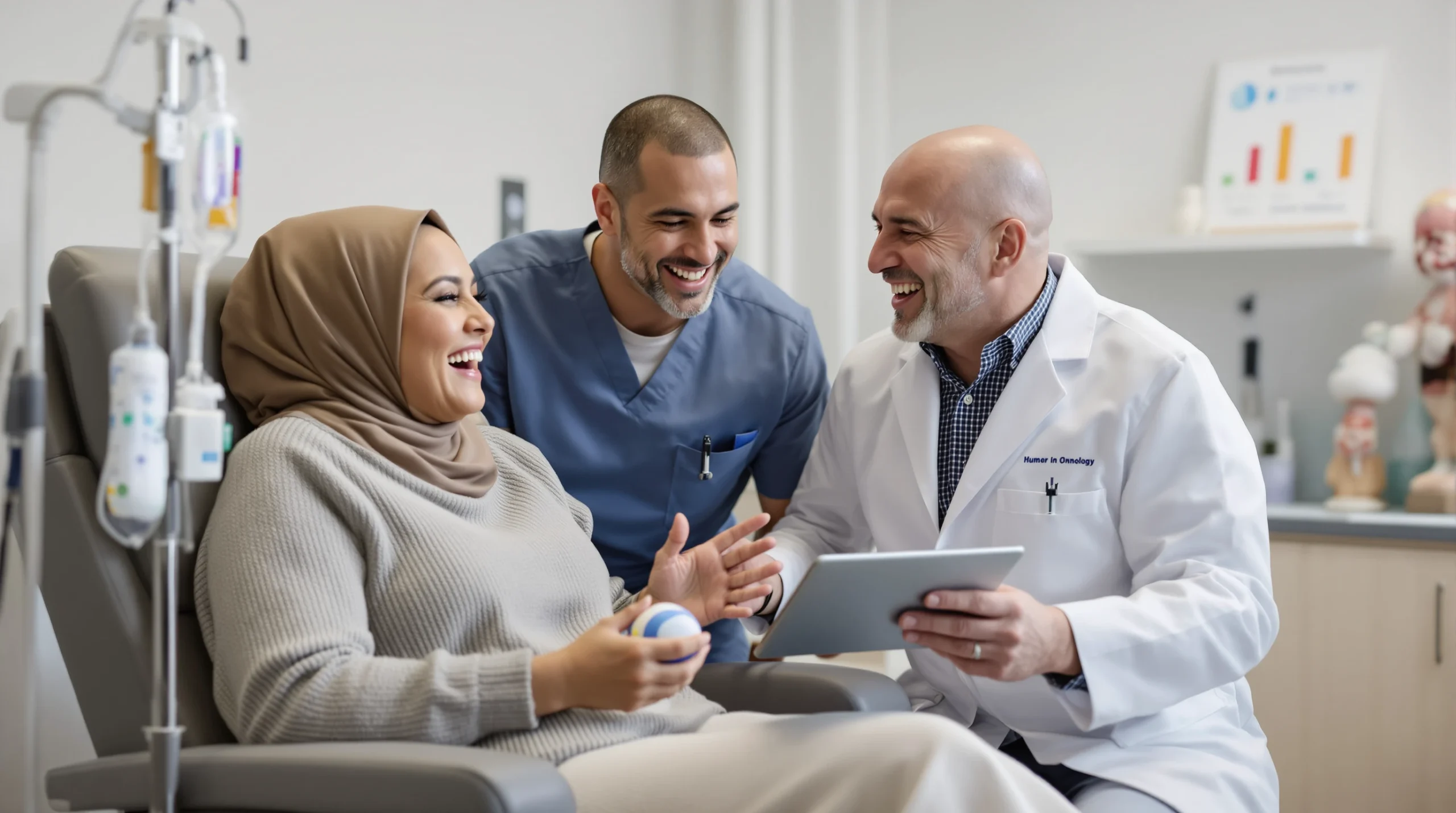
Humor in Oncology: What the Science Reveals
Humor in oncology is an evidence-based clinical approach using therapeutic laughter to reduce patient anxiety, improve care relationships, and support pain management during cancer treatment – here’s what the research shows.
Table of Contents
- What Is Humor in Oncology?
- What Do Cancer Patients Actually Think About Humor in Their Care?
- How Does Laughter Produce Measurable Clinical Benefits?
- How Oncology Providers Are Already Using Humor
- Frequently Asked Questions
- Approaches to Humor in Oncology: A Comparison
- How LaughMD Supports Humor in Oncology
- How to Integrate Humor in Oncology in 5 Steps
- The Bottom Line
- Sources & Citations
Key Takeaway
Humor in oncology is the deliberate, evidence-based use of therapeutic laughter and comedic interaction within cancer care settings to reduce patient anxiety, lower pain perception, and strengthen the clinician-patient relationship. Over 400 peer-reviewed studies support its use as a legitimate, side-effect-free clinical tool.
Humor in Oncology in Context
- 86% of radiotherapy patients said it was somewhat or very important for health care providers to use appropriate humor during cancer center visits (The importance of humour in oncology: a survey of patients undergoing radiotherapy, 2020)[1]
- 79% of patients in the same 2020 survey reported that humor decreased their anxiety during cancer treatment (The importance of humour in oncology: a survey of patients undergoing radiotherapy, 2020)[1]
- 97% of oncology specialists in a Dutch survey cited by ASCO in 2024 reported using humor in interactions with patients (Journal of Clinical Oncology / ASCO, 2024)[2]
- 85% of patients in a humor group during breast cancer screening remembered their radiologist’s name, compared to 30% in the comparison group (Humor in radiological breast cancer screening, 2017)[3]
What Is Humor in Oncology?
Humor in oncology is the deliberate clinical application of laughter, levity, and comedic interaction within cancer care to improve patient wellbeing and therapeutic outcomes. LaughMD – founded by Prof. Frank Chindamo, CHP, a former Saturday Night Live writer turned Certified Humor Professional – is among the leading voices translating this research into practical clinical guidance for oncologists, nurses, and patients nationwide.
Cancer care is one of medicine’s most emotionally demanding environments. Patients face fear, chronic pain, prolonged treatment schedules, and significant uncertainty. Non-pharmacological interventions that cost nothing, carry no side effects, and are deployed in a 60-second clinical exchange deserve serious attention – and humor in oncology is exactly that kind of intervention.
The foundation of humor in oncology rests on well-documented physiological mechanisms. Laughter triggers endorphin release, reduces cortisol levels, and activates the immune system – all responses that are measurably beneficial in the oncology context. A USC Norris Cancer Center study using the LaughMD framework reported 91% pain relief among cancer patients receiving humor-based interventions. These are not anecdotal outcomes; they are peer-reviewed, institutionally validated results.
Clinical humor in cancer settings takes several forms: oncologists using appropriate levity during consultations, nurses incorporating light humor during chemotherapy sessions, patient-facing comedy content delivered via digital platforms, and structured comedy programs integrated into palliative and supportive care protocols. Each of these approaches draws from the same strong evidence base, and each is calibrated to the individual patient’s comfort and preferences.
Understanding what humor in oncology is – and is not – matters enormously. Humor in oncology does not minimize a patient’s diagnosis. It does not make jokes at a patient’s expense. Humor in oncology is the thoughtful, patient-centered use of shared laughter to create psychological safety, reduce physiological stress markers, and strengthen the therapeutic alliance between providers and the people in their care.
What Do Cancer Patients Actually Think About Humor in Their Care?
Cancer patients overwhelmingly support the use of appropriate humor by their care teams, and the data from peer-reviewed surveys makes that preference impossible to ignore. A 2020 survey of patients undergoing radiotherapy found that 86% said it was somewhat important or very important for health care providers to use appropriate humor during visits to the cancer center (The importance of humour in oncology: a survey of patients undergoing radiotherapy, 2020)[1]. That figure is not a soft preference – it represents a clear patient mandate.
The anxiety-reduction finding is equally compelling. As the authors of the radiotherapy patient survey noted in 2020: “Most respondents (79%) said that humour decreased anxiety, and 86% indicated that laughing was considered somewhat important or very important.” (The importance of humour in oncology: a survey of patients undergoing radiotherapy, 2020)[1] For patients navigating a cancer diagnosis, anxiety is not a minor inconvenience – it is a clinical problem that affects treatment adherence, pain perception, sleep quality, and immune function. Any intervention that reduces anxiety in 79% of patients deserves a place in the standard of care conversation.
Patients also use humor themselves as a coping tool. The same 2020 radiotherapy survey found that 61% of patients said they used humor frequently or always when dealing with their individual cancers (The importance of humour in oncology: a survey of patients undergoing radiotherapy, 2020)[1]. Humor in oncology is not something being imposed on patients – it is something many patients already bring to the clinical encounter, and providers have an opportunity to meet them there.
Research published in the Journal of Clinical Oncology adds further texture to the patient perspective. Katarzyna Kraj, an oncology clinician at Ottawa Hospital Cancer Centre, summarized the findings this way in 2024: “A stunning 86% of patients felt that laughter was somewhat or very important to their care, whereas 79% felt that humor decreased their level of anxiety about their diagnosis.” (Just Humor Me, Journal of Clinical Oncology / ASCO, 2024)[2]
The breast cancer screening setting offers another angle on patient response. When a radiologist used humor during a mammogram consultation, patients in the humor group remembered the radiologist’s name at 85%, compared to just 30% in the comparison group (Humor in radiological breast cancer screening, 2017)[3]. Better recall of the provider’s name signals stronger rapport, greater trust, and a more positive experience of an otherwise anxiety-inducing encounter. These outcomes matter for follow-up adherence and patient satisfaction scores alike.
How Does Laughter Produce Measurable Clinical Benefits?
Laughter produces measurable clinical benefits by triggering a cascade of physiological responses – endorphin release, cortisol suppression, and immune activation – that directly counteract the biological stress load that cancer treatment places on the body. These mechanisms are documented across a substantial body of peer-reviewed literature and explain why humor in oncology produces the outcome data researchers find in clinical trials.
Cortisol is the body’s primary stress hormone, and elevated cortisol is closely associated with impaired immune function, increased pain sensitivity, and disrupted sleep – all of which worsen quality of life for cancer patients. Laughter measurably reduces circulating cortisol levels, creating a physiological environment that is more conducive to healing and more receptive to treatment. When oncology nurses at a US cancer center introduce comedy content during chemotherapy sessions, they are not just lifting the mood in the room – they are shifting the patient’s hormonal profile in a clinically meaningful direction.
The endorphin mechanism is equally important for pain management. Endorphins are the body’s natural analgesics, and genuine laughter stimulates their release in ways that produce real, measurable reductions in pain perception. This is the mechanism behind the USC Norris Cancer Center study result: 91% of patients reported pain relief following humor-based intervention. Endorphin-mediated pain relief is drug-free, instantaneous, and has no adverse event profile – a combination that no pharmacological agent can match.
Immune function is a third pathway. Natural killer cell activity, antibody production, and T-cell responsiveness all show improvement following sustained laughter interventions. For cancer patients, whose immune systems are frequently compromised by treatment, any intervention that supports immune resilience carries genuine therapeutic value. UCLA Health’s clinical resources on laughter and wellbeing reinforce this evidence, noting immune benefits as among the most consistently documented outcomes of therapeutic laughter.
A 2005 review published on PubMed synthesized the literature clearly: “The literature indicated that various types of humorous material lessened anxiety and discomfort, which allowed for patients’ concerns and fears to be discussed openly.” (The impact of humor on patients with cancer, 2005)[4] That last phrase – allowing concerns and fears to be discussed openly – points to a clinical benefit beyond physiology. Humor in oncology creates psychological safety that enables better clinical communication, more complete symptom reporting, and stronger therapeutic alliance. These outcomes improve care quality in ways that are difficult to achieve through medication alone.
How Oncology Providers Are Already Using Humor
Oncology providers are already integrating humor into clinical practice at rates that surprise those who assume cancer care is uniformly solemn. A Dutch survey of oncology specialists cited in the Journal of Clinical Oncology in 2024 found that 97% of specialists reported using humor in interactions with patients, and 100% reported laughing during consultations at least occasionally (Journal of Clinical Oncology / ASCO, 2024)[2]. The question is no longer whether oncologists use humor – it is whether they are using it intentionally, skillfully, and with a framework that maximizes its clinical benefit.
The same 2024 ASCO data showed that 71% of oncologists reported using humor sometimes and 26% reported frequent use (Journal of Clinical Oncology / ASCO, 2024)[2]. That distribution suggests most providers use humor reactively – following the patient’s lead when a light moment arises – rather than proactively deploying it as a structured therapeutic tool. The distinction matters because reactive humor captures some benefit, but deliberate, patient-centered humor intervention captures measurably more.
Provider wellbeing is a second dimension of humor in oncology that deserves attention. Oncology is among the highest-burnout specialties in medicine. The Chapman University study referenced in the LaughMD framework demonstrated a 13% reduction in provider-reported stress in just three minutes of structured humor exposure. A hospital administrator who introduces a brief, structured humor break protocol at shift handover is not just improving staff morale – they are implementing an evidence-based intervention with documented stress-reduction outcomes.
The peer-reviewed research on humor in healthcare settings consistently supports provider-initiated humor as a tool for improving both patient experience and clinician resilience. Training providers to use humor skillfully – knowing when to introduce it, how to calibrate it to the patient’s cues, and how to avoid humor that diminishes or dismisses – is an achievable goal. A framework grounded in the evidence rather than instinct alone makes that training effective without requiring extensive resources or lengthy programs.
Practical provider-led humor approaches documented in clinical settings include brief comedic exchanges during triage, curated comedy content offered to patients during infusion therapy, and structured levity protocols embedded in shift handover meetings. Each of these approaches has a corresponding evidence base, and each is low-cost enough to be implemented across healthcare systems of any size.
Your Most Common Questions
Is humor in oncology appropriate when patients are seriously ill or in significant pain?
Humor in oncology is appropriate for seriously ill and pain-affected patients when it is patient-led, context-sensitive, and grounded in genuine rapport rather than deflection. The evidence consistently shows that cancer patients – including those in active treatment and palliative care – not only tolerate humor but actively value it. A 2020 radiotherapy survey found that 86% of patients considered provider humor important to their care, and 79% reported that it decreased their anxiety (The importance of humour in oncology: a survey of patients undergoing radiotherapy, 2020)[1]. These patients were not in the early stages of a mild diagnosis – they were undergoing radiotherapy. The key clinical distinction is between humor that acknowledges the patient’s reality with warmth and humor that minimizes, dismisses, or trivializes their experience. The former builds trust and reduces physiological stress markers including cortisol. The latter damages the therapeutic relationship. Skilled providers calibrate humor to the individual patient’s cues: following the patient’s lead, using self-deprecating rather than patient-directed humor, and pairing levity with clear and compassionate communication about the patient’s condition. The AT Still University study showing 60% chronic pain reduction through comedy-based intervention demonstrates that even patients with significant, ongoing pain benefit meaningfully from humor in oncology when it is delivered with clinical intentionality.
What types of humor work best in oncology settings?
The types of humor that work best in oncology settings are self-deprecating humor, observational humor about shared experiences, and patient-initiated humor that the provider mirrors with warmth and reciprocity. Research on humor in cancer care consistently identifies patient-centered, non-stigmatizing humor as the most therapeutically effective form. A 2005 PubMed-indexed review of humor and cancer patients found that humorous material that lessened anxiety and opened space for patients to discuss their fears was most beneficial (The impact of humor on patients with cancer, 2005)[4]. Humor that targets the patient’s diagnosis directly, relies on gallows humor without patient initiation, or uses irony that could be misread as dismissiveness should be avoided. Curated comedy content – comedy films, stand-up clips, humorous audio content matched to individual patient preferences – bypasses the need for provider comedic skill entirely while still delivering the physiological benefits of laughter. Digital platforms like the LaughMD app use personalized comedy curation to match content to patient preferences, ensuring the humor is relevant and genuinely funny to the individual rather than generic. The breast cancer screening study from 2017 found that radiologist-initiated humor improved patient recall of the provider’s name from 30% to 85% and reduced patient anxiety (Humor in radiological breast cancer screening, 2017)[3] – outcomes that speak directly to the relational quality that good clinical humor builds.
Does humor in oncology have any documented effect on pain reduction?
Humor in oncology has documented, peer-reviewed evidence of significant pain reduction across multiple clinical study settings, with the USC Norris Cancer Center reporting 91% patient-reported pain relief through humor-based intervention. That result exceeds many pharmacological comparators without any adverse event profile. The mechanism is physiological: genuine laughter triggers endorphin release, and endorphins are the body’s natural analgesic system. Laughter also reduces circulating cortisol, which is closely associated with elevated pain sensitivity. The AT Still University study found a 60% reduction in chronic pain through comedy-based intervention, demonstrating that the effect is reproducible across different patient populations and clinical settings. The Mayo Clinic’s resources on laughter and stress relief also document the pain-reduction mechanism, noting that laughter activates the release of natural painkillers. For oncology patients managing treatment-related pain alongside disease-related pain, humor-based intervention offers a complementary approach that reduces analgesic requirements, supports safer deprescribing, and improves overall quality of life. These outcomes reflect a well-understood biological pathway that clinical humor interventions intentionally activate.
How can a hospital or cancer center implement a humor in oncology program?
A hospital or cancer center implements a humor in oncology program by starting with a structured, evidence-based framework – such as the LaughMD framework – that provides staff training, patient-facing resources, and measurable outcome protocols. Implementation does not require significant financial investment or dedicated humor staff. The Chapman University study demonstrated a 13% reduction in provider stress in just three minutes of structured humor exposure, which means brief, low-intensity interventions produce clinically meaningful results. A practical starting point is introducing curated comedy content during infusion therapy – patients select from a library of comedy films or stand-up clips during chemotherapy sessions. This approach has been validated at US cancer centers and requires only a device and content library to deploy. Staff-facing implementation begins with a three-minute structured humor break embedded in shift handover meetings, using the Chapman University protocol as a guide. Provider training on patient-centered humor – covering when to introduce humor, how to follow patient cues, and which humor styles to avoid – is delivered in a single continuing medical education session. For institutions seeking a comprehensive academic and clinical foundation, the LaughMD ebook and audiobook by Prof. Frank Chindamo, CHP, provide over 400 study citations, specific outcome data from USC, Chapman, and AT Still University, and a step-by-step implementation prescription for clinicians and administrators. Contact LaughMD at [email protected] for bulk institutional licensing and program support.
Approaches to Humor in Oncology: A Comparison
Humor in oncology is delivered through several distinct approaches, each with different resource requirements, scalability, and evidence bases. The table below compares the four most commonly documented methods across key clinical dimensions to help providers and administrators select the best fit for their setting.
| Approach | Resource Level | Evidence Strength | Anxiety Reduction | Pain Reduction | Provider Benefit |
|---|---|---|---|---|---|
| Provider-initiated conversational humor | Low – no additional resources required | Strong – 97% of oncologists already use it; 86% patient approval (Journal of Clinical Oncology / ASCO, 2024)[2] | High – 79% of patients report reduced anxiety[1] | Moderate – indirect via cortisol reduction | High – improves provider-patient rapport and reduces burnout |
| Curated comedy content (film, stand-up, audio) | Low-moderate – device and content library | Strong – USC Norris Cancer Center: 91% pain relief | High – sustained laughter sessions measurably reduce cortisol | High – direct endorphin-mediated pain relief | Moderate – reduces emotional exhaustion on wards |
| Structured humor break protocols (staff-facing) | Low – time investment only | Moderate-strong – Chapman University: 13% stress reduction in 3 minutes | Moderate – indirect via staff wellbeing improvement | Low direct effect; improves care quality indirectly | Very high – documented stress and burnout reduction |
| Personalized digital humor platforms | Moderate – requires platform subscription or licensing | Emerging – LaughMD app framework; AT Still University: 60% chronic pain reduction | High – personalized content improves engagement and anxiety outcomes | High – comedy tailored to individual preference maximizes endorphin response | Moderate – scalable tool reduces per-patient staff burden |
How LaughMD Supports Humor in Oncology
LaughMD was built specifically to bridge the gap between the strong peer-reviewed evidence for humor in oncology and the practical tools clinicians and patients need to act on it. Founded by Prof. Frank Chindamo, CHP – a former SNL writer, USC, UCLA, and Chapman University professor, and Certified Humor Professional – LaughMD brings a combination of academic authority and genuine comedic expertise that no conventional health publisher can replicate.
The flagship resource is the book If Laughter is the Best Medicine – Let’s Use It as Medicine: The New Science of Humor in Healthcare, available as a digital ebook, audiobook, and print edition through the LaughMD Shop. The book draws on over 400 peer-reviewed studies and presents the validated clinical outcomes from USC Norris Cancer Center (91% pain relief), Chapman University (13% provider stress reduction), and AT Still University (60% chronic pain reduction) in accessible, APA-cited chapters designed for both clinical and general audiences.
For oncology providers looking to implement humor-based programs, the book’s “How To” prescription section provides step-by-step guidance for clinicians, administrators, and patients. Over 100 embedded YouTube links illustrate key concepts in the digital edition, and QR codes in the print edition provide smartphone access to the same content – making it practical for clinic waiting rooms and institutional libraries alike.
The sister entity LaughMD extends the framework into a personalized digital wellness app that curates comedy content matched to individual patient preferences, enabling scalable delivery in both home and clinical settings. For oncology wards and cancer centers seeking a ready-to-deploy patient-facing tool, the LaughMD platform addresses precisely the implementation challenge that most institutions face: how to deliver humor intervention consistently, at scale, without requiring additional trained staff for every patient interaction.
“Prof. Chindamo’s work provides a comprehensive and funny exploration of why humor belongs in the healing process. It’s an essential resource for practitioners and patients alike.” – Gina Ramsey, LICSW – Author, Writer, Speaker, Life Transformation Strategist at Minneapolis VA Healthcare System
“A compelling presentation of science and clinical application. This hilarious book proves how laughter is a legitimate, data-backed medical intervention.” – Joseph B. Singer, MD – Senior Attending Physician at East Bay Community Action Program, Providence, RI
For institutions interested in bulk orders, curriculum licensing, or media partnerships, the LaughMD contact page handles all inquiries. Email [email protected] to discuss institutional licensing or CME integration directly with the team.
How to Integrate Humor in Oncology in 5 Steps
Step 1: Assess Patient Readiness and Comedy Preferences
Before introducing any humor-based intervention, conduct a brief, informal assessment of the patient’s current emotional state and comedy preferences. Ask whether they enjoy comedy films, stand-up, or light humor in conversation, and note any cultural or personal factors that shape their response. This step ensures humor in oncology is patient-centered from the first interaction and prevents well-intentioned levity from landing poorly.
Step 2: Build a Curated Comedy Content Library
Assemble a library of vetted comedy content – stand-up clips, short films, humorous audiobook excerpts – that patients access via tablet or smartphone during infusion sessions, waiting periods, or home recovery. Drawing on the LaughMD framework, prioritize content that has been matched to diverse patient demographics and is free of humor styles that stigmatize illness or disability. The LaughMD digital platform offers a ready-to-deploy solution for institutions that prefer not to curate content from scratch.
Step 3: Train Providers in Patient-Centered Clinical Humor
Deliver a focused training session – ideally integrated into a continuing medical education module – covering the physiological mechanisms of therapeutic laughter, the types of humor most effective in oncology settings, and the clinical boundaries that ensure humor supports rather than undermines the patient relationship. This training need not exceed a single session; the LaughMD ebook provides APA-cited content appropriate for CME use.
Step 4: Implement a Structured Staff Humor Protocol
Introduce a brief, structured humor break into shift handover meetings – three minutes of shared comedy content, following the Chapman University protocol that demonstrated a 13% reduction in provider stress in that timeframe. Consistent implementation across departments builds a ward culture that sustains humor in oncology as an ongoing practice rather than a one-time initiative, reducing burnout and improving team cohesion over time.
Step 5: Measure Outcomes and Refine the Program
Use validated patient-reported outcome measures – including anxiety scales, pain scores, and patient satisfaction surveys – to track the impact of humor in oncology interventions across your patient population. Collect provider wellbeing data through periodic stress and burnout surveys. Review the data quarterly and use it to refine content curation, adjust training frequency, and show the program’s value to hospital administrators and accreditation bodies. Peer-reviewed studies from the LaughMD framework provide benchmarks: 91% pain relief and 60% chronic pain reduction are the clinical targets a well-implemented program should aspire toward.
The Bottom Line
Humor in oncology is no longer a fringe concept or a soft skill – it is a peer-reviewed, clinically validated intervention with documented outcomes in pain reduction, anxiety management, and provider wellbeing. The data is consistent: 86% of cancer patients want appropriate humor from their care teams, 79% report it reduces their anxiety, and clinical trials at USC, AT Still University, and Chapman University have produced outcome percentages that rival pharmacological comparators with zero adverse events.
The opportunity for oncology providers, administrators, and patients is clear. Humor-based interventions are low-cost, immediately deployable, and grounded in the same biological mechanisms that underpin established pain management approaches. What has been missing – until now – is an accessible, evidence-based resource that translates over 400 studies into practical clinical guidance.
LaughMD provides exactly that. Whether you are a clinician looking to implement a ward-level humor protocol, a patient seeking a complementary approach to managing treatment-related pain, or an administrator evaluating non-pharmacological interventions for your cancer center, we have the resources to support your next step. Visit the LaughMD Shop to access the ebook, audiobook, and print editions, or reach out directly at [email protected] to discuss institutional licensing and bulk orders.
Sources & Citations
- The importance of humour in oncology: a survey of patients undergoing radiotherapy. PMC / National Library of Medicine, 2020.
https://pmc.ncbi.nlm.nih.gov/articles/PMC7467787/ - Just Humor Me. Journal of Clinical Oncology / ASCO, 2024.
https://ascopubs.org/doi/10.1200/JCO.24.00791 - Humor in radiological breast cancer screening. ETH Research Collection, 2017.
https://www.research-collection.ethz.ch/server/api/core/bitstreams/63aa269b-d3a8-4324-b503-e52dcb289493/content - The impact of humor on patients with cancer. PubMed / National Library of Medicine, 2005.
https://pubmed.ncbi.nlm.nih.gov/15853164/