
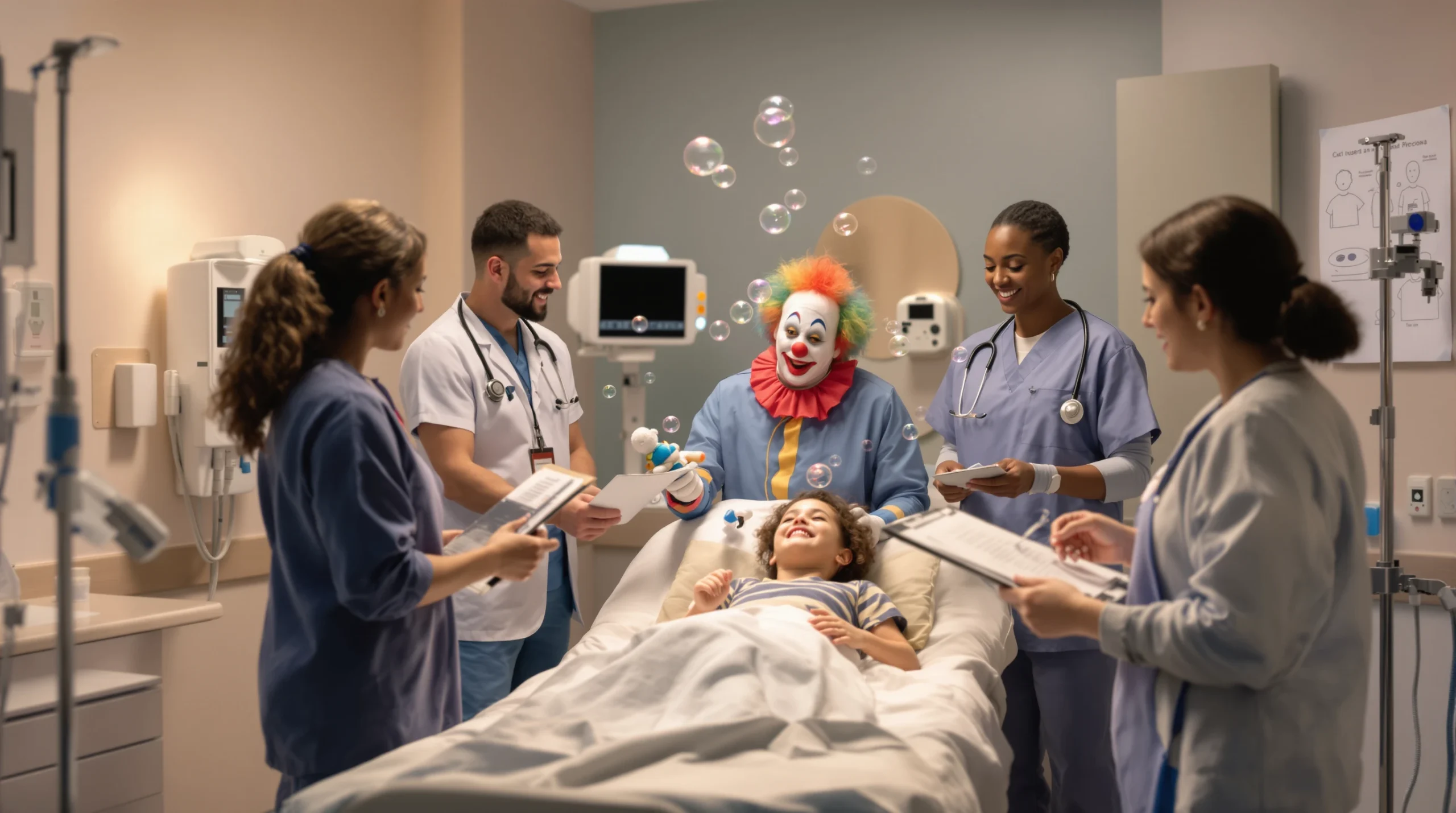
Medical Clown Training: Evidence-Based Clinical Humor
Medical clown training teaches evidence-based humor to reduce pediatric anxiety, manage procedural pain, and enhance patient outcomes in clinics.
Table of Contents
- Introduction
- What Does Medical Clown Training Entail?
- How Does Clinical Comedy Training Reduce Pediatric Anxiety?
- Why Is Evidence-Based Humor Important for Hospital Clown Certification?
- How Do Medical Clowning Courses Address Chronic and Procedural Pain?
- Important Questions About Medical Clown Training
- Comparing Therapeutic Clown Education Approaches
- How LaughMD Supports Clinical Comedy Training
- How to Implement Medical Clown Training in 4 Steps
- The Bottom Line
- Further Reading
Article Snapshot
Medical clown training is the specialized educational process that equips performers and healthcare workers with clinical humor interventions to manage patient distress. This structured curriculum integrates infection control, empathetic communication, and evidence-based laughter therapy techniques for safe hospital deployment.
By the Numbers
- 912 children were included in a 2023 meta-analysis showing that medical clowning significantly reduced procedural anxiety (National Library of Medicine, 2023) [1] .
- A 2024 meta-analysis revealed a standardized mean difference reduction in pain of -0.96 when clinical comedy training was applied to pediatric nursing (Frontiers in Pediatrics, 2024) [2] .
- Approximately 7 out of 8 children experience anxiety reduction through therapeutic clown education, reflecting a Number Needed to Treat of 1.143 (J Clin Nurs, 2022) [3] .
Introduction
Medical clown training develops well-intentioned entertainers into highly skilled clinical professionals capable of delivering measurable health outcomes. While traditional comedy focuses on stage performance, therapeutic clown education prepares individuals to work in complex hospital environments, adhere to strict infection control protocols, and apply evidence-based humor to alleviate patient distress. Healthcare institutions increasingly recognize that structured healthcare clowning programs reduce reliance on pharmacological interventions for procedural pain and anxiety.
LaughMD explores the science of humor in healthcare, showing how clinical comedy training aligns with rigorous academic research from institutions like USC and Chapman University. Founded by Prof. Frank Chindamo, CHP, our framework bridges the gap between comedic artistry and peer-reviewed medical interventions. Whether you are a performer seeking hospital clown certification or a clinician exploring non-pharmacological pain management, understanding the curriculum behind these programs is important. You can explore our foundational methodology on the About LaughMD page. This article examines the core competencies, clinical evidence, and practical implementation strategies that define modern medical clowning courses.
What Does Medical Clown Training Entail?
Medical clown training encompasses a multidisciplinary curriculum designed to teach performers how to apply humor safely within clinical environments. Unlike standard improvisation classes, these programs require students to master medical terminology, hospital etiquette, and the psychological nuances of patient vulnerability. The foundation of any reputable therapeutic clown education begins with infection control and patient safety. Trainees must learn how to sanitize props, recognize immunocompromised states, and move through sterile fields without disrupting ongoing medical care, echoing findings on the benefits of laughter for older adults and diverse populations.
Beyond physical safety, hospital clown certification demands a deep understanding of empathetic communication and trauma-informed care. Students study how to read non-verbal cues from patients who are non-verbal, intubated, or experiencing severe cognitive impairment. The curriculum emphasizes the therapeutic alliance, teaching clowns to adjust their comedic pacing based on a patient’s real-time physiological and emotional responses. This clinical comedy training ensures that humor is deployed as a targeted non-pharmacological intervention rather than a random distraction.
Healthcare clowning programs also integrate psychological adjustment strategies to help patients cope with symptom clusters. Trainees learn to differentiate between acute procedural anxiety and chronic existential distress, applying specific comedic frameworks to each scenario. For instance, distraction techniques are prioritized during venipuncture, while narrative-based humor is more appropriate for long-term oncology patients. By grounding their practice in peer-reviewed literature, graduates of medical clowning courses articulate the precise mechanisms-such as cortisol reduction and endorphin release-that make their interventions effective. This academic rigor advances the profession, ensuring that hospital administrators view certified humor professionals as integral members of the interdisciplinary care team.
How Does Clinical Comedy Training Reduce Pediatric Anxiety?
Clinical comedy training directly reduces pediatric anxiety by equipping practitioners with evidence-based distraction and emotional regulation techniques. When a child faces a painful procedure, the brain’s amygdala triggers a fight-or-flight response, amplifying the perception of pain. Graduates of therapeutic clown education are trained to interrupt this neurological cascade through carefully timed comedic interventions. By shifting the child’s cognitive focus away from the medical equipment and toward an engaging, humorous narrative, the clown effectively lowers the child’s physiological arousal.
The empirical backing for this approach is substantial. A 2023 meta-analysis of 14 randomized controlled studies involving 912 children found that procedures performed with a medical clown present produced significantly reduced anxiety scores compared with control conditions (National Library of Medicine, 2023) [1] . The presence of these trained professionals reduced children’s anxiety with a standardized mean difference of -0.76 on anxiety scores compared with controls (National Library of Medicine, 2023) [1] . This statistical significance highlights why medical clowning courses are increasingly mandated by top-tier pediatric hospitals.
The benefits also extend beyond the patient to include caregivers and medical staff. A 2024 meta-analysis on clown care in clinical nursing reported that children’s anxiety scores decreased with a standardized mean difference of -0.81, while caregivers’ anxiety levels decreased with a standardized mean difference of -0.99 when clown care was integrated into nursing (Frontiers in Pediatrics, 2024) [2] . As researchers analyzing clown care noted, the interventions were highly beneficial in reducing the pain, anxiety, and crying time of children and the anxiety level of caregivers (Frontiers in Pediatrics, 2024) [2] . By training clowns to engage the entire family unit, healthcare clowning programs create a more supportive healing environment that enables smoother clinical workflows and reduces overall ward stress.
Why Is Evidence-Based Humor Important for Hospital Clown Certification?
Evidence-based humor is important for hospital clown certification because it ensures that comedic interventions produce reliable, measurable health outcomes rather than unpredictable reactions. In a clinical setting, humor must be treated as a precise medical intervention with specific indications, contraindications, and dosages. Therapeutic clown education programs teach students to evaluate peer-reviewed literature, allowing them to base their routines on proven psychological and physiological mechanisms, a concept widely supported by stress relief through laughter research. This academic foundation separates certified humor professionals from amateur entertainers who inadvertently cause distress or violate clinical boundaries.
The necessity for rigorous methodology is underscored by the complexities of clinical research. As lead author Verónica Fusetti noted, clown therapy seems effective in reducing procedural pain and anxiety in children, but results should be considered with caution due to the methodological variations across studies (European Journal of Pediatrics, 2022) [4] . To address these variables, advanced medical clowning courses train practitioners to standardize their approaches, document patient outcomes, and participate in ongoing clinical audits. This commitment to data collection helps refine the LaughMD framework and similar methodologies, ensuring continuous improvement in care delivery.
Evidence-based training also enables clowns to collaborate effectively with physicians and nurses. When a certified professional explains that their intervention is designed to trigger endorphin release and mitigate the sympathetic nervous system’s stress response, they gain the trust of the medical team. A 2022 systematic review showed that school-aged children and adolescents receiving clown therapy had significantly less pain during venipuncture, with a standardized mean difference of -0.51 compared to standard care (European Journal of Pediatrics, 2022) [4] . Similarly, children’s anxiety with clown therapy was significantly lower than with standard care, showing a standardized mean difference reduction of -0.97 (European Journal of Pediatrics, 2022) [4] . These metrics provide hospital administrators with the quantitative justification needed to fund and integrate clinical comedy training into standard operating procedures.
How Do Medical Clowning Courses Address Chronic and Procedural Pain?
Medical clowning courses address chronic and procedural pain by teaching practitioners how to use humor as a potent non-pharmacological intervention. Pain perception is highly subjective and deeply influenced by emotional state, fear, and environmental stressors. Through specialized therapeutic clown education, clowns learn to manipulate the psychosocial environment, changing a sterile, intimidating treatment room into a space of psychological safety and play. This cognitive shift activates the brain’s reward pathways, prompting the release of endogenous opioids that naturally dampen pain signals, as detailed in this academic research article on humor in healthcare .
The impact of these techniques on procedural pain is well-documented in recent literature. A 2020 BMJ systematic review of hospital clowns synthesized 12 studies and found that children and adolescents in the presence of hospital clowns reported significantly less anxiety and better psychological adjustment before painful procedures and during the induction of anesthesia (BMJ, 2020) [5] . Researchers reporting on this review concluded that interaction with hospital clowns is a beneficial strategy to manage symptom clusters and improve psychological adjustment compared with standard care (BMJ, 2020) [5] . By incorporating these findings into their curriculum, healthcare clowning programs ensure that graduates are equipped to handle high-stakes clinical scenarios, such as preoperative preparation and oncology treatments.
For chronic pain management, the training shifts focus from acute distraction to long-term emotional resilience. Clowns are taught to build ongoing therapeutic alliances with patients enduring prolonged hospitalizations, using recurring comedic motifs to create a sense of normalcy and control. A 2025 quasi-experimental study highlighted this efficacy, reporting that children receiving preoperative clown therapy had significantly lower anxiety, with mean mYPAS scores of 5.57 compared to 6.18 in controls (European Journal of Pediatrics, 2025) [6] . Also, a network meta-analysis of 28 studies confirmed that clowning produced significantly lower pediatric anxiety scores compared with the presence of parents alone during medical procedures (Maastricht University, 2023) [7] . These outcomes validate the LaughMD approach, proving that structured clinical comedy training is an indispensable tool in modern pain management protocols.
Important Questions About Medical Clown Training
What is the difference between medical clown training and regular comedy classes?
Medical clown training focuses on clinical safety, infection control, and evidence-based therapeutic interventions, whereas regular comedy classes prioritize stage performance and audience entertainment. Therapeutic clown education requires students to master hospital etiquette, trauma-informed care, and the psychological nuances of patient vulnerability. While a stand-up comedian aims to elicit laughs from a crowd, a certified humor professional uses targeted comedic pacing to reduce cortisol levels and manage procedural pain in individual patients. This specialized curriculum ensures that clowns can move through sterile fields, recognize immunocompromised states, and collaborate smoothly with interdisciplinary medical teams without disrupting critical care workflows.
How long does it take to complete hospital clown certification?
Hospital clown certification requires several months of intensive coursework, followed by supervised clinical practicums in healthcare settings. The duration varies depending on the specific healthcare clowning program, but most reputable medical clowning courses demand a minimum of 100 to 200 hours of combined classroom instruction and bedside shadowing. Students must pass rigorous evaluations in infection control, empathetic communication, and clinical comedy training before they are cleared to work independently. This extensive timeline ensures that graduates possess the emotional resilience and academic knowledge necessary to apply evidence-based humor safely among highly vulnerable patient populations.
Can nurses and doctors benefit from therapeutic clown education?
Nurses and doctors significantly benefit from therapeutic clown education by integrating humor into daily patient interactions to reduce burnout and improve care quality. While clinical comedy training is often associated with professional clowns, the underlying principles of laughter therapy are highly applicable to conventional medical staff. Healthcare providers who understand the mechanisms of endorphin release and psychological adjustment use micro-interventions to ease patient anxiety during routine procedures. Engaging with humor-based coping strategies has been shown to reduce provider stress, creating a more resilient and compassionate clinical workforce.
Is there scientific proof that medical clowning courses improve patient outcomes?
Yes, there is substantial scientific proof that medical clowning courses improve patient outcomes by teaching techniques that measurably reduce pain and anxiety. A comprehensive 2022 systematic review estimated that clown therapy reduced children’s anxiety with an effect size corresponding to a Number Needed to Treat of approximately 1.143, meaning about 7 out of every 8 children treated experience a reduction in anxiety (J Clin Nurs, 2022) [3] . Co-author Dinesh Sirisha Sridharan confirmed that medical clowns have substantial positive and beneficial effects on reducing stress and anxiety in children and their families in various circumstances in pediatrics (Semanticscholar, 2020) [8] . These peer-reviewed metrics validate the clinical necessity of rigorous therapeutic clown education.
Comparing Therapeutic Clown Education Approaches
Understanding the different approaches to therapeutic clown education helps healthcare institutions select the right framework for their specific patient demographics and clinical goals. While some programs focus heavily on improvisational theater, others prioritize rigorous academic research and physiological symptom management. Evaluating these methodologies ensures that hospitals invest in clinical comedy training that yields measurable, evidence-based outcomes.
| Approach | Primary Focus | Target Audience | Key Outcome Metric |
|---|---|---|---|
| Improvisational Arts | Spontaneous play and theatrical distraction | Pediatric wards, general entertainment | Patient engagement and smiling frequency |
| Evidence-Based Clinical | Peer-reviewed interventions and physiological symptom management | Oncology, preoperative care, chronic pain | Standardized mean difference reduction in anxiety [1][2] |
| Psychosocial Support | Emotional resilience and long-term coping strategies | Palliative care, long-term hospitalization | Caregiver stress reduction and psychological adjustment [5] |
Hospitals prioritizing data-driven care favor the evidence-based clinical approach, as it aligns with the LaughMD framework and produces quantifiable reductions in procedural pain. By selecting medical clowning courses that emphasize academic rigor, institutions ensure their staff confidently integrate humor into comprehensive treatment plans, ultimately reducing the need for heavy sedation and shortening overall recovery times.
How LaughMD Supports Clinical Comedy Training
LaughMD provides the foundational research and educational resources necessary to advance clinical comedy training and therapeutic clown education worldwide. Founded by Prof. Frank Chindamo, CHP-a former Saturday Night Live writer and Certified Humor Professional-our organization bridges the gap between comedic artistry and rigorous medical science. We translate over 400 peer-reviewed studies into actionable guidance for healthcare providers, patients, and professional clowns seeking to improve their practice. Our framework is validated by remarkable clinical outcomes, including a 91% pain relief rate at the USC Norris Cancer Center and a 13% reduction in provider stress at Chapman University.
For professionals pursuing hospital clown certification, our comprehensive digital resources offer deep insights into the mechanisms of laughter therapy, cortisol reduction, and non-pharmacological pain management. ‘Prof. Chindamo’s work provides a comprehensive and funny exploration of why humor belongs in the healing process. It’s an important resource for practitioners and patients alike.’ – Gina Ramsey, LICSW, Minneapolis VA Healthcare System .
We invite you to explore our LaughMD Shop to access our definitive eBook, ‘If Laughter is the Best Medicine, Let’s Use It as Medicine.’ This resource is indispensable for anyone involved in medical clowning courses or interdisciplinary care teams. For institutional licensing or bulk orders for your hospital’s therapeutic clown education program, please use our Contact LaughMD form. Discover how our evidence-based frameworks improve your clinical environment.
How to Implement Medical Clown Training in 4 Steps
Assess Clinical Needs and Target Demographics
Begin by evaluating the specific needs of your healthcare facility, identifying whether procedural pain, chronic illness, or provider burnout requires the most urgent intervention. Analyzing patient demographics ensures that the therapeutic clown education curriculum you select is tailored to the appropriate age groups and cognitive abilities, maximizing the effectiveness of the clinical comedy training.
Select an Evidence-Based Certification Program
Choose medical clowning courses that prioritize peer-reviewed research, infection control, and trauma-informed care over pure theatrical performance. Verify that the hospital clown certification program includes supervised clinical practicums and requires students to show proficiency in reducing standardized anxiety scores before graduation.
Integrate Clowns into Interdisciplinary Care Teams
Embed certified humor professionals directly into daily ward rounds and preoperative briefings to ensure smooth collaboration with nurses and physicians. This integration allows the medical clown to review patient charts, identify contraindications, and deploy evidence-based humor precisely when procedural pain or anxiety is anticipated to peak.
Measure Outcomes and Refine Protocols
Establish a continuous feedback loop by tracking patient-reported outcome measures, such as pain scales and caregiver stress levels, following each clown intervention. Use this quantitative data to refine the healthcare clowning program, ensuring that the laughter therapy techniques remain aligned with the latest academic research and institutional goals.
The Bottom Line
Medical clown training represents a significant evolution in modern healthcare, changing humor from a casual distraction into a rigorous, evidence-based medical intervention. By equipping practitioners with specialized skills in infection control, empathetic communication, and psychological adjustment, therapeutic clown education ensures that vulnerable patients receive safe, effective, and measurable relief from procedural pain and anxiety. The extensive clinical data validating these healthcare clowning programs proves that laughter therapy is a powerful ally in the fight against patient distress and provider burnout.
As institutions seek to reduce reliance on pharmacological interventions, investing in clinical comedy training and hospital clown certification becomes a strategic imperative. To explore the science behind these interventions and access premium resources for your practice, visit the LaughMD Shop today. Contact our team at [email protected] to discuss institutional licensing and bring the proven benefits of the LaughMD framework to your clinical environment.
Further Reading
- Effectiveness of medical clowning on pediatric anxiety and pain: A meta-analysis. National Library of Medicine (PMC).
https://pmc.ncbi.nlm.nih.gov/articles/PMC10533584/ - Clown care in the clinical nursing of children: a meta-analysis and systematic review. Frontiers in Pediatrics.
https://pmc.ncbi.nlm.nih.gov/articles/PMC10999578/ - Clown therapy for anxiety reduction: A systematic review summary. J Clin Nurs via Semantic Scholar.
https://pdfs.semanticscholar.org/af6c/5ac258fea645559f8c7d396bf6fc487f57cf.pdf - Clown therapy for procedural pain in children: a systematic review and meta-analysis. European Journal of Pediatrics via PubMed.
https://pubmed.ncbi.nlm.nih.gov/35294645/ - Effectiveness of hospital clowns for symptom management in paediatrics: systematic review. BMJ.
https://www.bmj.com/content/371/bmj.m4290 - Preoperative clown therapy and pediatric anxiety: A quasi-experimental study. European Journal of Pediatrics via PubMed.
https://pubmed.ncbi.nlm.nih.gov/41270656/ - Effectiveness of Hospital Clowning on Pediatric Anxiety and Pain. Maastricht University.
https://cris.maastrichtuniversity.nl/en/publications/effectiveness-of-hospital-clowning-on-pediatric-anxiety-and-pain- - Therapeutic clowns in pediatrics: a systematic review and meta-analysis. Semantic Scholar.
https://www.semanticscholar.org/paper/Therapeutic-clowns-in-pediatrics:-a-systematic-and-Sridharan-Sivaramakrishnan/bae9eca0aa4b652c3cec9b511fa26614b1064857


